Time:2026-01-16 17:56:49 Number of Clicks:
As a professional manufacturer in the global bulk material conveying equipment industry, ZOOMRY has been deeply engaged in the R&D and production of core products such as belt conveyors, telescopic stackers, mobile ship loaders, as well as key components including idlers, pulleys, and cleaning scrapers, serving customers around the world. Combining industry practical experience and international benchmarking standards, we have sorted out some common questions for you, with an FAQ table attached at the end for quick reference.
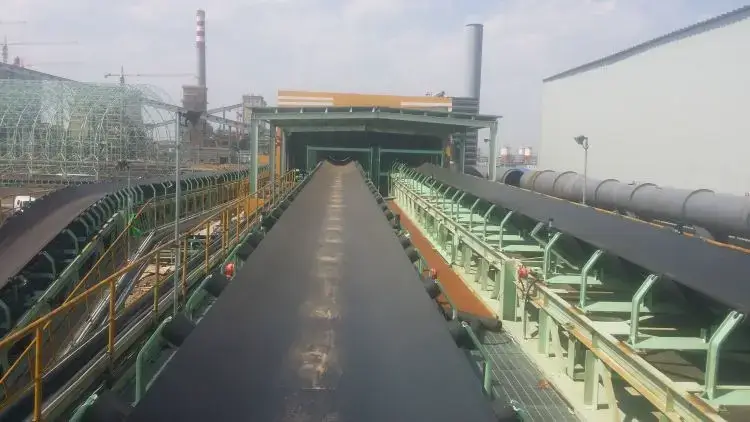
Reducer selection needs to consider multiple aspects. First, load characteristics: it is necessary to clarify whether the belt conveyor operates under constant load or impact load (e.g., large material drop in the mining industry is prone to impact). For impact loads, the service factor needs to be further increased to avoid component damage caused by instantaneous load. Second, motor power and transmission ratio: based on the designed conveying capacity, belt speed and pulley speed of the belt conveyor, the output torque of the reducer should be accurately matched. The calculation formula should combine load torque, starting torque and safety factor. The selection of service factor should take into account brand characteristics and working conditions. Due to differences in materials and craftsmanship, it is recommended that the service factor of domestic reducers should not be less than 2.0 under general working conditions, and be increased to 2.5-3.0 under heavy-duty and frequent start-stop conditions. Thanks to core technological advantages, imported brands (such as mainstream brands in the industry) can control the service factor at 1.5-2.0 under general working conditions, and adjust it to above 2.0 under special working conditions. Third, heat capacity adaptation: long-term continuous operation of belt conveyors is likely to cause reducer temperature rise. It is necessary to select models with forced cooling devices or increased heat dissipation area according to ambient temperature (high or low temperature) and heat dissipation conditions (outdoor or closed corridor), to prevent excessive oil temperature from affecting lubrication performance. International standards have clear requirements for the thermal equilibrium temperature of reducers, and the operating temperature must be ensured not to exceed 100℃. Fourth, installation space and method: according to the layout of the belt conveyor (horizontal or inclined) and on-site space limitations, select horizontal, vertical or shaft-mounted reducers. At the same time, it should match the international standards (such as ISO standards) of flanges, couplings and other connectors to ensure compatibility with motors and pulleys. Finally, maintenance convenience: combined with the customer's on-site maintenance capacity, select models that are easy to disassemble and have strong spare part universality. The reducers matched by ZOOMRY are compatible with international general spare parts, reducing maintenance costs for overseas customers.
In addition, the selection should refer to relevant international standards (such as ISO 6336 Gear Strength Standard). For the characteristics of heavy load, dust and continuous operation in the bulk material conveying industry, reducers with high gear precision and good sealing performance should be preferred. ZOOMRY can provide customized selection schemes according to the specific working conditions of customers, balancing reliability and economy.
As the core equipment for bulk material conveying, the operating conditions of belt conveyors have uncertainties such as material fluctuations and environmental changes. Therefore, reasonable margin (redundancy) must be reserved in the design stage, which is the key to ensuring the long-term stable operation of the equipment and avoiding fault risks. Moreover, the redundancy design must comply with international industry specifications to adapt to different application scenarios around the world.
The margin design of core parameters is as follows: In terms of conveying capacity, the conventional design margin coefficient is 1.15-1.25, which means the conveying capacity is allowed to fluctuate within 115% of the designed capacity. For scenarios with unstable material output such as mines and ports, the margin coefficient can be increased to 1.3 to avoid equipment overload caused by short-term material surge. ZOOMRY will accurately calculate the conveying capacity redundancy based on the customer's material characteristics (such as particle size and bulk density) to ensure adaptation to actual production fluctuations. In terms of motor power, the redundancy design needs to cover starting impact, operating resistance fluctuations and special environmental impacts (such as low temperature and high altitude). The power margin coefficient under conventional working conditions is 1.2-1.4, and it needs to be increased to 1.4-1.6 under low-temperature and heavy-duty starting conditions. At the same time, it should be combined with motor energy efficiency standards (such as IEC IE3/IE4 High-Efficiency Motor Standards) to balance energy consumption optimization while ensuring redundancy, in line with global environmental protection requirements. In terms of belt safety factor, it must strictly follow international standards (such as ISO 5048) and be set according to the belt material (steel cord belt, fabric core belt) and stress conditions. The safety factor of steel cord belts is usually 6-8, and that of fabric core belts is 8-10, to avoid belt breakage accidents caused by fatigue and impact. The belts matched by ZOOMRY have all passed third-party testing to ensure that the safety factor meets the standards.
In addition, key components such as idler sets, pulleys and chutes also need to reserve structural redundancy. For example, the idler load margin coefficient is not less than 1.2, and the pulley shaft strength margin coefficient is not less than 1.3, to cope with wear and load fluctuations during long-term operation. Reasonable redundancy design is not to excessively increase the specifications, but to accurately calculate based on working conditions. With years of experience in domestic and overseas projects, ZOOMRY can achieve a balance between redundancy and cost, ensuring the reliability of equipment in various complex scenarios.
The core intelligent configurations for unattended operation include: First, tracked intelligent inspection robot: laying dedicated tracks along the belt conveyor corridor, integrating high-definition cameras, noise sensors, temperature sensors, fire detectors and deviation recognition modules, which can conduct 24/7 uninterrupted along-line inspection with a detection accuracy of ±0.5℃ (temperature) and ±1dB (noise). It supports the switching between remote control and autonomous cruise, and uploads data to the central control platform in real time, replacing manual labor to complete high-risk and repetitive inspection work, which has been successfully applied in Southeast Asian port projects. Second, intelligent automatic lubrication device: for easy-wear components such as idler and pulley bearings, a timing and quantitative lubrication system is adopted, which can automatically adjust the oil injection volume according to the equipment operation time and load conditions, and is compatible with different brands of lubricating grease (complying with ISO VG standards). It is equipped with grease level monitoring and leakage alarm functions to avoid component damage caused by insufficient or excessive lubrication, extending the service life of bearings by more than 30%. Third, drive device online monitoring system: installing vibration sensors (vibration accuracy ±0.1mm/s) and temperature sensors on core drive components such as motors and reducers to monitor vibration frequency and temperature rise data in real time. It predicts equipment faults (such as bearing wear and gear failure) through algorithm analysis and issues early warnings with a response time of no more than 10 seconds. Fourth, intelligent image recognition system: combining AI algorithms with high-definition cameras to realize face recognition (prohibiting irrelevant personnel from entering), foreign object intrusion recognition (such as personnel and debris invading the corridor), and belt deviation and tear recognition (deviation detection accuracy ±5mm, tear recognition accuracy over 99%). At the same time, it can link with alarm devices and equipment emergency shutdown systems to prevent safety accidents. Fifth, central control integrated management platform: integrating data from all intelligent devices, supporting remote monitoring on multiple terminals (computers, mobile phone APPs), with functions such as data statistics and analysis, fault traceability, and maintenance work order generation. It is compatible with international general communication protocols (such as Modbus and Profinet) and can be connected to the customer's existing factory management system to realize full-process unmanned control.
In addition, auxiliary configurations such as intelligent dust prevention and automatic deviation correction can be added according to customer needs. ZOOMRY's intelligent solutions have all passed international explosion-proof and anti-interference certifications, adapting to voltage standards and network environments in different overseas regions, helping customers achieve cost reduction, efficiency improvement and safe production.
Low-temperature environments in cold regions (such as Northern Europe, Siberia, Canada, etc., with the minimum temperature reaching below -40℃) will cause problems such as material embrittlement, increased operating resistance and lubrication failure of belt conveyors. Combining the experience of overseas cold region projects, ZOOMRY has formulated a special scheme from three aspects: material selection, structural design and system configuration to ensure the stable operation of equipment.
The primary attention is cold-resistant material adaptation: the belt should be made of cold-resistant materials with a minimum service temperature not higher than -40℃, preferably neoprene or nitrile rubber, to avoid belt hardening and cracking at low temperatures. At the same time, the belt carcass layer should be enhanced in flexibility, complying with ASTM D4023 Low Temperature Resistance Standard. The steel should be selected with grades with excellent low-temperature impact toughness, such as Q355D/E and S355JR, to ensure no brittle fracture risk at low temperatures. The outer shells of idlers and pulleys are coated with cold-resistant and anti-corrosion coatings to resist low-temperature rain and snow erosion. The lubricating grease should be low-temperature type (such as ISO VG 22 low-temperature lubricating grease) with a dropping point not lower than 120℃ and good low-temperature fluidity, to avoid solidification failure at low temperatures. Meanwhile, a grease heating device should be equipped to preheat to a suitable temperature before startup.
Second is motor and transmission system optimization: the motor should be cold-resistant type, equipped with stator heating device and thermal insulation cover to avoid difficult startup or winding damp at low temperatures. The motor power coefficient is increased by 10%-20% compared with conventional working conditions to cope with the problems of increased material viscosity and belt friction resistance at low temperatures. The reducer should be strengthened in sealing and thermal insulation design to prevent low-temperature air from invading and causing gear oil solidification, and an electric heating jacket can be added to ensure the normal circulation of lubricating oil.
Finally is structural and protective design: the main stress-bearing components such as belt conveyor supports and chutes need to be subjected to strength calculation under low-temperature working conditions, and reinforced structures are adopted to avoid deformation caused by low-temperature stress concentration. The corridor should be added with thermal insulation layer, and temperature monitoring and automatic heating devices should be installed at key parts (such as motors and reducers). The belt should be preheated before operation to avoid component damage caused by impact load during low-temperature startup. ZOOMRY has provided multiple sets of special belt conveyors for cold regions for Nordic mining projects, all of which have passed long-term low-temperature working condition verification.
Pulley lagging is a key measure to improve the transmission efficiency of belt conveyors and extend the service life of pulleys and belts. It can effectively increase the friction between pulleys and belts, prevent slipping, and reduce wear at the same time. ZOOMRY provides a full range of pulley lagging products, covering four mainstream types, which can be accurately selected according to working conditions, environment, cost and international standard requirements.
The four types of lagging and their characteristics are as follows: First, cast lagging: divided into flat, diamond and chevron patterns, it is the most widely used type in the bulk material conveying industry at present. Made mainly of natural rubber, it has strong wear resistance (Shore hardness 60-70A) and high adhesion, and can adapt to heavy-duty and normal temperature (-20℃ to 60℃) working conditions. The diamond pattern can enhance drainage performance, suitable for humid environments; the chevron pattern can effectively prevent belt deviation, suitable for long-distance belt conveyors. Cast lagging needs to be prefabricated in the factory with high quality stability, complying with ISO 4649 standard. Second, cold bonding lagging: bonding the rubber plate to the pulley surface with special cold bonding adhesive, which can be constructed on-site without large-scale equipment and has a short construction period. It is suitable for on-site emergency repair or scenarios where pulleys cannot be disassembled. The rubber plate material can be natural rubber, nitrile rubber, etc., adapting to different material characteristics. However, it has high requirements for construction technology, which needs to control surface treatment, adhesive coating thickness and curing time. In addition, the quality of adhesive and rubber plate must meet the standards (such as selecting adhesives complying with FDA standards for food-grade material scenarios). ZOOMRY can provide professional on-site construction teams to ensure bonding quality. Third, ceramic lagging: composed of ceramic blocks and rubber composite, it has an extremely high friction coefficient (≥0.8), and its wear resistance is 3-5 times that of ordinary cast lagging, suitable for high-strength and high-wear working conditions (such as mine heavy-duty belt conveyors). However, the ceramic material is brittle, prone to cracking and falling off in low-temperature environments (below -10℃), and the cost is high, so it is not suitable for cold regions or scenarios with severe vibration. Fourth, shell lagging: adopting modular shell structure, fixed on the pulley surface by welding, with convenient installation and on-site replacement. The material is mainly wear-resistant rubber, but it has poor adhesion and sealing performance, easy to enter water and dust leading to falling off. At present, it is less used, only suitable for light-load and temporary emergency repair scenarios.
The core principles of selection: cast lagging (diamond or chevron pattern) is preferred under conventional working conditions, balancing cost performance and reliability; diamond or chevron pattern cast lagging is selected for humid and easy-deviation working conditions; cold bonding lagging is selected for on-site emergency repair and scenarios where factory prefabrication is not possible, with strict control of construction technology; ceramic lagging is selected for high-strength wear and normal temperature working conditions; shell lagging can be selected for light-load temporary scenarios. At the same time, it is necessary to combine environmental temperature, material characteristics (such as corrosion-resistant rubber plates for corrosive materials) and international standard requirements. ZOOMRY can provide lagging material test reports to ensure compliance with overseas project specifications.
Both pipe belt conveyors and trough belt conveyors are core equipment for bulk material conveying, each with its own advantages and disadvantages. Pipe belt conveyors cannot completely replace trough belt conveyors, and the selection needs to be comprehensively judged based on project scenarios, environmental protection requirements, cost budgets and international standards. ZOOMRY can provide customers with optimal selection suggestions based on domestic and overseas project experience.
The core advantages of pipe belt conveyors are fully enclosed structure, which can completely prevent material dust emission and scattering, suitable for scenarios with extremely high environmental protection requirements (such as urban surrounding areas and food-grade material conveying). It can also realize curved conveying, adapting to complex terrain. However, it has obvious disadvantages: the energy consumption is more than 50% higher than that of trough belt conveyors, because the pipe belt needs to overcome greater bending resistance and friction resistance during operation; the service life of idlers and belts is short, the idlers of pipe belt conveyors need to bear both radial and axial loads, resulting in fast wear speed. Due to the long-term curled state of the belt, its fatigue life is 20%-30% shorter than that of trough belts; the maintenance difficulty is high, the closed structure leads to inconvenient fault diagnosis and maintenance, and the spare parts have poor universality, resulting in high overseas maintenance costs; the investment cost is high, 30%-50% higher than that of trough belt conveyors with the same conveying capacity; under the same conveying capacity and belt speed conditions, the bandwidth of pipe belt conveyors needs to be 15%-20% larger than that of trough belt conveyors, occupying more space.
Trough belt conveyors are currently the most widely used bulk material conveying equipment, with advantages of low energy consumption, simple structure, convenient maintenance, low investment cost, long service life of idlers and belts, and strong universality of spare parts (complying with international general standards). They are suitable for most bulk material conveying scenarios (mines, ports, chemical industry, etc.). For dust emission problems, it can be solved by installing rainproof and dustproof covers and optimizing the sealing structure. The dustproof cover of ZOOMRY's trough belt conveyors adopts a modular design with a protection class of IP54, complying with international environmental protection standards, which can effectively suppress dust emission and meet the environmental protection requirements of most projects.
Feasibility judgment of replacement: pipe belt conveyors can be considered only when the project has strict closed environmental protection requirements, the terrain is complex requiring curved conveying, and the customer can accept high energy consumption and high cost; under most conventional scenarios, trough belt conveyors can meet the requirements by adding dustproof devices, with better cost performance and practicability. In many overseas projects, ZOOMRY has successfully replaced pipe belt conveyors by optimizing the dustproof design of trough belt conveyors, reducing investment and operation and maintenance costs for customers.
Dust emission along the belt conveyor corridor not only pollutes the environment, but also accelerates equipment wear and affects the health of operators. Comprehensive prevention and control measures need to be taken based on material characteristics, working conditions and international environmental protection standards. Based on global project experience, ZOOMRY has formed a mature dust emission prevention and control scheme, adapting to different environmental protection requirements at home and abroad.
The core prevention and control measures include: First, optimizing the belt cleaning system, which is the key to suppressing dust emission. The head discharge point should be equipped with a multi-stage cleaning device: the first stage uses a cemented carbide scraper to remove most of the material residues, and the second stage uses an elastic scraper for refined cleaning to ensure that the residual material on the belt surface is less than 0.5kg/m², avoiding dust emission caused by material scattering on the lower belt surface. At the same time, regularly check the wear of cleaning scrapers and replace them in time to ensure cleaning effect. ZOOMRY's cleaning scrapers are made of wear-resistant materials, adapting to different belt types, complying with ISO 3408 standard. Second, installing belt turning device: turning the dirty surface of the lower belt upward to facilitate centralized cleaning of residual materials, avoiding material scattering in the corridor. The turning device needs to be linked with the cleaning system to ensure that the cleaned materials are uniformly collected into the hopper without being left in the corridor. Third, strengthening sealing protection: the upper belt surface can be equipped with a rainproof and dustproof cover with a sealed structure, and the interface is sealed with rubber sealing strips to prevent material dust emission caused by strong wind weather. The dustproof cover material can be color steel plate or fiberglass, adapting to different corrosive environments; the entire corridor can adopt a fully enclosed design with a protection class of IP54 or above. For key parts such as the head and tail, the sealing structure should be optimized to prevent dust overflow.
Auxiliary prevention and control measures: for dry and easy-to-dust materials (such as coal and ore powder), a spray dust suppression system can be installed in the corridor, using high-pressure atomizing nozzles to control the dust concentration below 10mg/m³, complying with international environmental protection standards (such as EU EN 1672-3 standard); optimize the chute design, add buffer devices and dustproof baffles in the chute to reduce impact dust emission when materials fall. At the same time, the contact part between the chute outlet and the belt adopts a sealed structure to suppress dust diffusion; regularly clean the corridor, configure automatic cleaning robots to avoid dust accumulation, and ensure good ventilation in the corridor to prevent potential safety hazards caused by excessive dust concentration.
ZOOMRY's dust emission prevention and control scheme can be customized according to the environmental protection standards of the customer's region. For example, for the strict environmental protection requirements in Europe, it can be upgraded to a triple prevention and control system of "cleaning + sealing + spray" to ensure up-to-standard emission, which has been successfully applied in overseas projects such as Germany and France.
As the power core of belt conveyors, the motor power specifications need to be accurately selected based on factors such as belt conveyor conveying capacity, belt speed, material characteristics and working conditions. ZOOMRY selects high-efficiency motors complying with IEC international standards, with power covering a full range of common specifications, adapting to different voltage levels (220V, 380V, 400V, 690V, etc.) and frequencies (50Hz/60Hz) at home and abroad to meet the needs of global customers.
Common motor power specifications (unit: kW): 5.5, 7.5, 11, 15, 18.5, 22, 30, 37, 45, 55, 75, 90, 110, 132, 160, 185, 200, 220, 250, 280, 315, 355, 400, 450, 500, 560, 630, 710, 800, 900, 1000, 1120. The above specifications cover the needs of light-duty to heavy-duty belt conveyors: motors of 5.5-45kW are commonly used for light-duty belt conveyors (such as chemical and grain conveying); motors of 55-250kW are commonly used for medium-duty belt conveyors (such as port and building material conveying); motors of 280-1120kW are commonly used for heavy-duty belt conveyors (such as mine and metallurgical conveying).
The principles of power selection are as follows: calculate the required rated power combined with the belt conveyor load, and reserve a power redundancy of 10%-20% (it needs to be increased to 20%-30% under special working conditions such as low temperature and heavy load); give priority to high-efficiency motors (IE3/IE4 level) to comply with the global trend of energy conservation and environmental protection, reducing operating energy consumption; select motors adapted to voltage and frequency according to the power grid standards of the overseas project region. ZOOMRY can provide customized motor configurations, and match with reducers, frequency converters and other components at the same time to ensure the adaptability and stability of the power system. In addition, for super-large power demand, a multi-motor drive scheme can be adopted to balance load distribution and improve the reliability of equipment operation, which has been successfully applied in overseas large-scale mining projects.
| Questions | Core Answer Points |
|---|---|
| How to Select a Reducer? What are the Basis? | Select based on load characteristics, motor power & transmission ratio, heat capacity, installation space and maintenance convenience; the service factor of domestic reducers ≥2.0 under general working conditions, imported ones ≥1.5, and adjust upward under special working conditions, referring to ISO 6336 standard. |
| Is There Any Margin Considered in Belt Conveyor Design? | Conveying capacity margin coefficient 1.15-1.3, motor power 1.2-1.6, belt safety factor 6-10 according to material (following ISO 5048); key components reserve structural redundancy simultaneously, balancing reliability and cost. |
| What Intelligent Configurations are Required to Achieve Unattended Operation? | Including tracked inspection robot, automatic lubrication device, drive device online monitoring system, intelligent image recognition system and central control integrated platform, compatible with international communication protocols, supporting 24/7 automatic monitoring and early warning. |
| What Precautions Should Be Taken for Belt Conveyors in Cold Regions? | Select cold-resistant materials (belt, steel, lubricating grease), increase motor power coefficient by 10%-20%, equip with heating and thermal insulation devices, conduct low-temperature strength calculation and reinforcement for key components, complying with standards such as ASTM D4023. |
| What are the Types of Pulley Lagging? How to Select? | Divided into cast lagging (widely used for conventional conditions), cold bonding lagging (on-site construction for emergency repair), ceramic lagging (high wear resistance, avoid low temperature) and shell lagging (light-load temporary scenarios); select according to working conditions and environment. |
| Can Pipe Belt Conveyors Replace Trough Belt Conveyors? | Cannot completely replace; pipe belt conveyors have fully enclosed dust prevention but high energy consumption & cost and difficult maintenance; trough belt conveyors have high cost performance and convenient maintenance, which can meet most environmental protection requirements by adding dustproof covers, select on demand. |
| What are the Measures to Avoid Dust Emission Along the Corridor? | Optimize multi-stage cleaning system, install belt turning device, strengthen dustproof sealing (dustproof cover, fully enclosed corridor), auxiliary spray dust suppression, adapting to international environmental standards such as EU EN 1672-3. |
| What are the Common Specifications of Motor Power? | Covering 5.5-1120kW series, adapting to light, medium and heavy-duty belt conveyors; select IE3/IE4 high-efficiency motors, compatible with global voltage and frequency standards, customized multi-motor drive scheme available. |
If this article does not solve your problem, you can click the picture below to contact us, or view other historical articles: FAQs on Belt Conveyors and Other Bulk Material Handling Equipment, Core Technical FAQs on Belt Conveyors (Part 2), ZOOMRY Belt Conveyor Core Technology and Application FAQ (Issue 3)


Enter your email to contact us quickly!
Copyright © 2002-2024 Zoomry Group Company Limited