Time:2025-12-02 15:54:23 Number of Clicks:
Drawing on years of experience in international projects, ZOOMRY has compiled the following FAQs addressing high-frequency industry questions to provide professional references for global customers. For quick reference, please refer to the FAQ table at the end of the article.
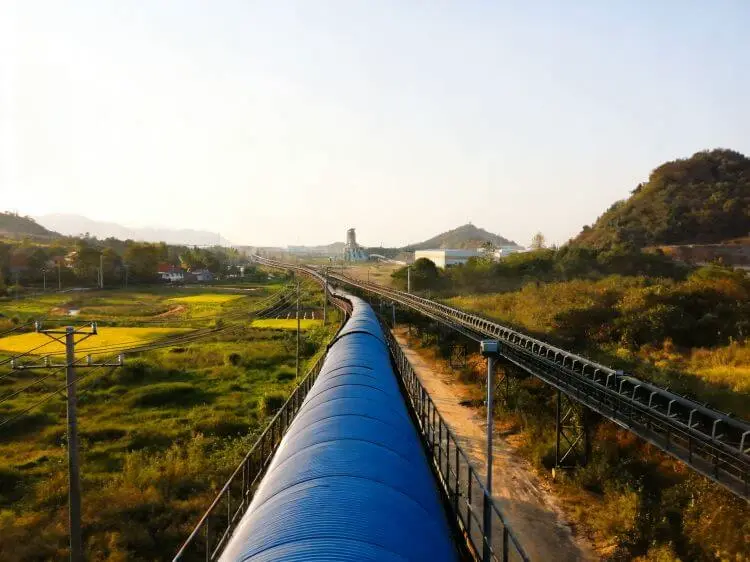
In addition, based on international industrial demands, ZOOMRY's belts can be customized with special properties such as wear resistance, cold resistance, heat resistance, and flame retardancy: Wear-resistant type is suitable for abrasive materials such as ore and coal; Cold-resistant type can operate stably in low-temperature environments below -40℃, adapting to projects in high-latitude regions; Heat-resistant type can withstand temperatures above 120℃, meeting the requirements of high-temperature material transportation in the metallurgy and building materials industries; Flame-retardant type is certified by relevant international standards such as MT/T 147-2011, making it an essential choice for underground conveying.
In newly-built bulk material conveying projects worldwide, fully enclosed galleries have become the mainstream choice. They not only effectively prevent material dust emission and rain erosion, complying with international environmental protection requirements but also protect equipment from external environmental corrosion, extending service life. The truss structures of galleries are mainly divided into three types: upper-opening type, lower-opening type, and integrated type:
The enclosure materials of galleries usually adopt a combination of profiled color steel plates and lighting panels. Profiled color steel plates have high strength and good waterproof performance, while lighting panels can utilize natural light to reduce lighting energy consumption in the gallery, aligning with the global trend of green industrial development. For projects in marine climates or chemical industries with high anti-corrosion requirements, fluorocarbon-coated color steel plates are also used to enhance the material's corrosion resistance.
In accordance with relevant ISO standards and universal global industry specifications, the widths of inspection passages and walkways in conveyor galleries must meet the requirements of safe operation and maintenance: The minimum clear width of the inspection passage shall not be less than 500mm to ensure maintenance personnel can pass smoothly with tools; The minimum clear width of the walkway shall not be less than 700mm, adapting to normal personnel walking and emergency evacuation.
In actual project design, ZOOMRY will optimize based on factors such as the customer's equipment maintenance frequency and personnel traffic needs: For galleries with dense large-scale equipment, the passage width will be appropriately increased to 800-1000mm; Evacuation spaces will be set at key locations such as bends and equipment interfaces to further improve operational safety, fully complying with international safety certification requirements such as EU CE and US ANSI.
The turning radius of a conveyor depends on belt width, belt tension, turning angle, operating environment, etc.:
The setting of safety exits in enclosed galleries (trestles) and tunnels must strictly comply with international safety standards to ensure personnel evacuation safety in emergencies. According to ISO and relevant national standards:
The span design of a conveyor gallery needs to comprehensively consider multiple factors such as project environment, load conditions, belt width, and material weight, and the optimal scheme shall be determined through professional structural calculations. Currently, the commonly used span range in the global industry is 18m-30m. This range can not only ensure structural stability but also control construction costs, making it the preferred choice for most projects.
When the span exceeds 30m, it is usually referred to as a long-span gallery. Its truss structure needs to adopt high-strength steel and require special wind resistance and seismic design, resulting in increased equipment weight and construction costs. ZOOMRY has completed a long-span truss project with a span of 80m, providing customized solutions for large-scale projects with complex terrain. However, from the perspective of economy and practicality, it is still recommended that customers optimize the path as much as possible during the project planning stage to avoid long-span design.
In the early stage of the project, ZOOMRY will provide customers with detailed selection analysis reports, recommending the optimal gallery type based on factors such as project terrain, budget, and construction period to ensure the economy and practicality of the project.
From a technical perspective, the top space of conveyor galleries is open, and most of them are north-south oriented (adjusted according to sunlight conditions in some regions), featuring good photovoltaic power generation conditions. The electrical energy generated by solar panels can be used for gallery lighting, equipment driving, etc., achieving energy self-sufficiency.
However, it should be noted that the installation of solar panels for long-distance linear projects needs to focus on investment return rate: The initial investment and later maintenance costs of solar panels, as well as local sunlight duration, electricity price policies, subsidy standards, etc., will all affect the economic benefits of the project. ZOOMRY recommends that customers conduct detailed feasibility analysis before making a decision, and formulate a reasonable solar panel installation plan based on the energy demand during the project life cycle to ensure the unity of economic and environmental value of the project.
The turning function of belt conveyors is realized through specialized arc-shaped trough idlers, with the core technical principles as follows:
In the furnace charging scenario of iron and steel enterprises, one conveyor needs to deliver 4-5 types of materials to different silos. The core of accurate discharging lies in the scientific arrangement and program control of plow dischargers. ZOOMRY's customized solution is as follows:
| Questions | Core Answers |
|---|---|
| What are the common belt types? | Mainly include Steel Cord Conveyor Belt (ST, highest tensile strength), Fabric Ply Conveyor Belt (EP/NN/CC, suitable for short distances within 300m), Solid Woven Conveyor Belt (PVC/PVG, including flame-retardant/anti-static types), and Aramid Fabric Core Conveyor Belt (DPP, limited applications); can be customized with special properties such as wear resistance, cold resistance, heat resistance, and flame retardancy. |
| What are the common types and structures of conveyor galleries? | Newly-built projects mainly adopt fully enclosed galleries. The truss structures are divided into upper-opening type (most widely used), lower-opening type (less used), and integrated type (high load-bearing capacity, light weight); the enclosure materials are mostly profiled color steel plates + lighting panels. |
| What is the minimum clear width of inspection passages and walkways in galleries? | Inspection passage ≥500mm, walkway ≥700mm; key positions can be appropriately widened with reserved evacuation spaces. |
| How to design the conveyor turning radius? | The ideal turning radius of conventional belt conveyors is 1000 times the belt width; for pipe conveyors, fabric ply type ≥400 times the pipe diameter, steel cord type ≥800 times the pipe diameter; it is recommended to maximize the turning radius when site conditions permit. |
| What are the requirements for setting safety exits in enclosed galleries and tunnels? | Safety exits must be set on the walkway side with a maximum spacing of ≤150m; personnel shelters can be added if setting is difficult in tunnels. |
| What is the commonly used span range of conveyor galleries? | The commonly used span is 18m-30m, which shall be determined through professional calculations; spans >30m are long-span, and it is recommended to avoid them as much as possible to control costs. |
| How to choose between tunnel galleries and steel structure galleries? | Tunnel galleries have higher costs and construction periods affected by geology, suitable for scenarios crossing mountains/buildings; steel structure galleries have controllable costs, short construction periods, and convenient maintenance, making them the preferred choice for most plain/hilly projects. |
| Can solar panels be installed on conveyor galleries? | Technically feasible with multiple practical cases; investment return rate needs to be evaluated based on factors such as sunlight, electricity prices, and subsidies. |
| What are the types of conveyor gallery foundations? | Raft-type reinforced concrete foundations are commonly used; pile foundations (including precast piles and cast-in-place piles) are adopted for poor geological conditions. |
| How is the turning of belt conveyors achieved? | The belt is guided to turn smoothly through specialized deep trough idler groups in the arc section (inner-side elevated design), and the installation angle of the idlers is used to prevent deviation. |
| In the furnace charging of iron and steel enterprises, how to arrange plow dischargers to achieve accurate batching? | Install corresponding dischargers according to silo positions, and control the action sequence through PLC programs; reserve empty spaces between different materials and match with sealed chutes to avoid spillage and mixing. |
As a professional global service provider in the bulk material handling field, ZOOMRY always adheres to international standards and provides a full range of products and customized solutions such as belt conveyors, mobile ship loaders, and truck unloaders, covering the entire life cycle services from equipment selection, design, production to installation and commissioning. If you have more technical questions or project needs, please consult ZOOMRY's global service team, and we will provide you with professional and efficient support.


Enter your email to contact us quickly!
Copyright © 2002-2024 Zoomry Group Company Limited