Time:2025-12-03 14:39:50 Number of Clicks:
Combining international industry standards and practical engineering cases, ZOOMRY provides professional answers to core questions such as sealing solutions, drive systems, and compliance requirements of belt conveyors, offering actionable technical references for global customers. A quick-reference FAQ table is attached at the end for easy browsing.
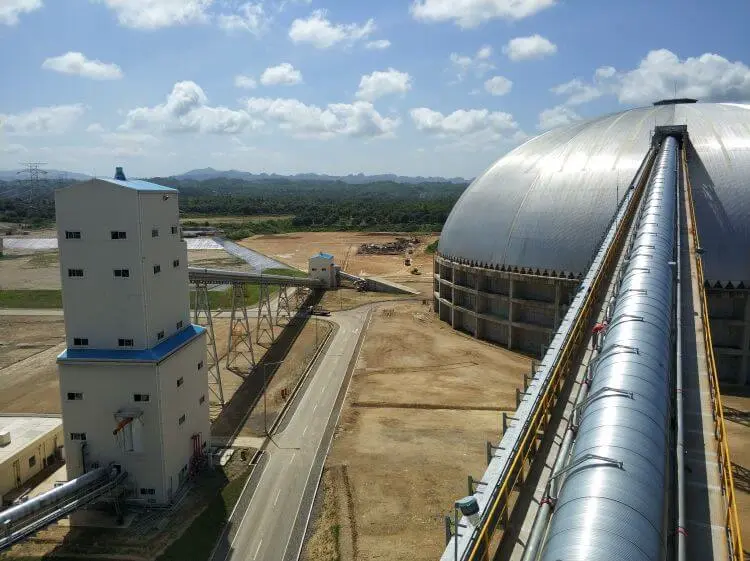
For dusty materials such as coal and ore, as well as sites with strict environmental protection requirements, the chute is generally designed as a fully enclosed structure. It adopts a composite design of steel plate cover + buffer channel, which not only ensures mechanical strength but also weakens the air impact when materials fall through the buffer channel, reducing dust emission. 2-3 layers of wear-resistant rubber skirts are installed at the contact part with the belt, forming a sealed barrier by closely fitting the belt surface to prevent material leakage from gaps.
Regarding the sewage treatment of belt conveyors, the logic of "pollution source control" must be clarified in practical engineering. Thanks to the conveyor's high-quality anti-deviation devices (such as self-aligning idler groups) and belt turnover protection design, there will be no material spillage or sewage leakage along the normally operating belt conveyor. The pollution risk is mainly concentrated in the head and tail transfer stations. For such scenarios:
It is worth noting that most bulk material conveying projects worldwide do not require additional complex sewage treatment facilities due to low material moisture content and improved on-site drainage systems. The core still lies in the anti-leakage design of the equipment itself.
Long-distance belt conveyors have extremely large inertial mass. If the free stopping time is too long during loaded shutdown, it may cause safety risks such as equipment collision and material spillage. Therefore, a large disc brake is generally installed at the tail, which can realize both normal shutdown and emergency braking functions. It adapts to different shutdown scenarios through multi-level torque adjustment—setting 2-3 different braking speeds, which can not only meet the stability requirements of conventional shutdown but also respond to rapid braking needs in case of sudden failures.
During startup:
The specific application scenarios of multi-point drive are divided into three categories:
When providing selection services for global customers, ZOOMRY usually takes "equipment length, conveying capacity, and power demand" as core indicators:
Regarding the questions of "whether it meets requirements if common galleries are not equipped with ventilation windows" and "whether steel grating walkways meet the standards of fully enclosed galleries", the core conclusion is: The current national standards (such as GB/T 10595-2023 "Belt Conveyors") do not impose mandatory requirements on gallery ventilation and walkway materials. The actual design must be comprehensively judged in combination with project scenarios and international standards.
From the perspective of practical application:
The so-called "permanent land acquisition" is not absolutely permanent, but refers to long-term use rights (similar to industrial land nature), usually 30-50 years of use rights can be applied for, covering only the projection range of the belt conveyor gallery; temporary land acquisition is mainly used for construction access roads, generally 4-8 meters wide. After the completion of construction, the land must be restored to its original state in accordance with local policies (such as reclamation and greening).
For long-term operation needs, some projects choose to include long-term access roads in the land acquisition scope, which not only meets the transportation needs during the construction phase but also provides convenient channels for later equipment inspection and maintenance. This scheme is widely used in countries with relatively loose land resources (such as Australia and Canada). In the execution of overseas projects, ZOOMRY usually assists customers in contacting local land management departments, formulating optimal land acquisition plans combined with project cycles and operation needs, ensuring compliance with local laws, regulations, and environmental protection requirements.
Belt conveyor dynamic analysis refers to the quantitative analysis of the interaction between key parameters such as belt speed, belt tension, and tensioning force during equipment startup and braking. For example, excessively fast startup speed will cause sudden increase in belt tension, insufficient tensioning force, roller slipping, and other problems, which may lead to belt tearing in severe cases.
At present, national standard design specifications do not mandatorily require dynamic calculation and analysis, but in long-distance, high-capacity belt conveyor projects, dynamic analysis has become an internationally recognized necessary link. Through dynamic analysis, startup time, braking torque, tensioning device parameters, etc., can be accurately optimized to ensure the stability of the equipment under full working conditions.
Global belt conveyor calculation software is mainly divided into international and domestic systems. Different software have different focuses based on calculation standards and applicable scenarios:
As a manufacturer with years of experience in the industry, ZOOMRY has independently developed a dedicated calculation program combining mainstream domestic and foreign calculation standards such as ISO, GB, and EN. It can flexibly adapt to international or domestic standards according to the project needs of customers from different countries, realizing full-process customized design from mechanical calculation and dynamic simulation to drawing generation, ensuring precise matching between equipment performance and project scenarios.
The core feature of downward conveyors is that the running resistance of the upper belt is negative (material gravity drives the belt to run). During the overall operation, the motor is in a power generation state, and its core function is "braking"—providing reverse torque through the motor to prevent the belt from overspeeding due to gravity acceleration. Therefore, the motor is usually installed at the tail to realize speed control by "pulling" the belt.
However, exceptions in special scenarios should be noted: If the downward angle is small (<2°), or only a local section of the undulating belt conveyor is downward, the driving force generated by material gravity is insufficient. In this case, the motor must be installed at the head to provide positive driving force and ensure stable operation of the equipment. In the design process, ZOOMRY conducts targeted calculations for specific parameters of each project (such as downward angle, material characteristics, and conveying distance), avoiding generalized design mistakes and ensuring the rationality of the motor installation position.
| Core Question | Solution/Key Conclusion |
|---|---|
| How to achieve effective sealing of the chute? | Fully enclosed design with steel plate + buffer channel cover and 2-3 layers of wear-resistant rubber skirts, adapting to international environmental standards |
| How to cope with braking and startup loads of long-distance belt conveyors? | Install large disc brakes at the tail (2-3 levels of braking speed); select frequency converter soft startup for long-distance equipment (startup time ≥3 minutes) |
| What are the precautions for land acquisition in belt conveyor projects? | Permanent land acquisition is for long-term use rights (30-50 years), covering the gallery projection; temporary land acquisition is for 4-8m wide construction access roads, which must be restored after completion |
| Is sewage treatment equipment required along the belt conveyor? | No material spillage/sewage along the line; collection pipelines can be installed at transfer stations, and sedimentation tanks for special projects; most projects do not need additional sewage treatment facilities |
| Is it compliant for enclosed galleries to have no ventilation windows and steel grating walkways? | No mandatory national standard requirements; color steel plate galleries have adequate natural ventilation, and steel grating walkways meet international safety standards |
| What is the core of belt conveyor dynamic analysis? | Analyze the interaction between startup/braking, belt speed, tension, and tensioning force; a necessary design link for long-distance projects |
| What are the mainstream belt conveyor calculation software? | International: BELT ANALYST, Sidewinder, ANSYS; Domestic: PDJCAD; ZOOMRY customized calculation program |
| Why are motors of downward conveyors mostly installed at the tail? | Motors play a braking role to prevent overspeeding; for downward angles <2° or local downward sections, motors can be installed at the head |
| Which scenarios are multi-point drives suitable for? | Long-distance, undulating terrain, and high-capacity belt conveyors; optimize tension distribution through multiple drive units at the head/tail/middle |
| How to select soft starters? | Short-distance/low-power: Hydraulic couplings, permanent magnet couplings; Long-distance/high-power: Frequency converter soft starters (recommended) |
If this article does not solve your problem, you can click the image below to contact us or view other historical articles: FAQs on Belt Conveyors and Other Bulk Material Handling Equipment


Enter your email to contact us quickly!
Copyright © 2002-2024 Zoomry Group Company Limited