Time:2026-01-04 14:09:56 Number of Clicks:
ZOOMRY specializes in the global bulk material handling equipment sector, with core products including a full range of equipment such as belt conveyors, telescopic stackers, mobile shiploaders, as well as key components like idlers and rollers. Our service network covers both domestic and international markets. This FAQ focuses on core issues related to the selection, operation, maintenance, and special working condition applications of belt conveyors. Combining international industry standards and engineering practice experience, we provide professional and comprehensive answers for global customers. A quick reference table of questions and answers is attached at the end for easy review.
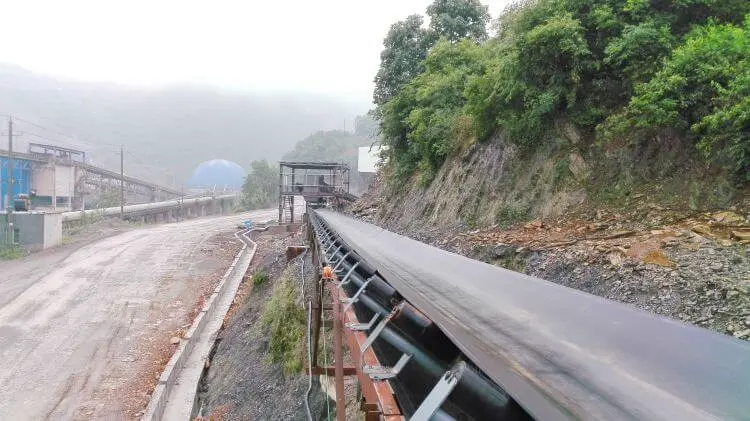
The core function of a belt conveyor's soft start device is to reduce the impact load during startup and avoid damage to the motor, belt, and transmission system. Based on technical principles, mainstream soft start methods can be divided into two categories: mechanical soft start and electrical soft start. The specific selection should be comprehensively judged based on core factors such as conveying distance, power capacity, and working conditions.
Mechanical soft start devices mainly include three types: hydraulic couplings, permanent magnet couplings, and Controlled Start Transmission (CST):
CST: Based on the working principle of a hydraulic oil clutch, it achieves smooth speed regulation by adjusting the pressure of hydraulic oil, enabling precise control of startup torque and acceleration. However, the system structure of this device is complex, and the core components require high machining precision, resulting in significantly higher equipment procurement costs and long-term maintenance costs compared to other types. Additionally, it has strict requirements for the technical level of maintenance personnel. Currently, it accounts for a relatively low proportion of applications in global bulk material handling projects and is only suitable for a small number of heavy-duty working conditions with special requirements for startup precision.
Hydraulic Coupling: As a mature technology with decades of application history, it transmits torque through a liquid medium to achieve flexible connection between the motor and load, effectively reducing startup impact. However, limited by its technical principle, its soft start performance has an obvious upper limit, with a narrow torque adjustment range and average startup stability. It is more suitable for short-distance belt conveyors (usually conveying length ≤50 meters) and low-power drive systems (power ≤160kW), and is widely used in small and medium-sized bulk material handling projects.
Permanent Magnet Coupling: Optimized and upgraded on the basis of hydraulic couplings, it adopts the principle of permanent magnet magnetic transmission to transmit torque without contact. It has the advantages of slightly better startup stability, lower energy consumption, and less maintenance. However, the improvement in soft start performance is limited, and its applicable scenarios are similar to those of hydraulic couplings. It is mainly used for medium-short distance, small and medium-power belt conveyors with certain energy-saving requirements.
For long-distance belt conveyors (conveying length >100 meters) and high-power drive systems (power ≥200kW), such as raw coal and ore conveying projects in large mines and ports, the global industry mainstream selection is the electrical variable frequency (VF) soft start device. Variable frequency soft start adjusts the output frequency and voltage through an inverter to achieve stepless speed regulation of the motor. It not only has a large startup torque (up to more than 1.5 times the rated torque) but also can accurately balance the power distribution of multi-motor drive systems, avoiding overload damage to individual motors. At the same time, it has the advantages of energy saving and consumption reduction, as well as stable braking, and can adapt to the efficient conveying needs under complex working conditions.
ZOOMRY belt conveyors adopt modular design and high-reliability components, featuring a simple overall structure, low post-maintenance requirements, and low failure rate, which are fully compatible with the operation and maintenance needs of customers in different regions around the world. For users without relevant maintenance experience, the company has established a comprehensive full-process technical support system to ensure the stable operation of equipment.
After the completion of project installation and commissioning, we will provide free systematic technical training for the user's maintenance personnel. The training content covers three core modules: first, equipment operation specifications, including key operation steps such as pre-startup inspection, operation parameter adjustment, and shutdown procedures, to ensure that operators proficiently master the equipment usage methods; second, common fault judgment and handling, through a combination of theoretical explanation and practical training, teaching the identification skills and quick solutions for common faults such as belt deviation, idler jamming, and motor overheating; third, spare parts management knowledge, clarifying the replacement cycle, replacement process, and precautions for core spare parts and wearing parts, and providing detailed spare parts and wearing parts catalogs. The catalogs include component models, specifications, applicable models, procurement channels, and inventory suggestions, facilitating users to accurately manage spare parts inventory.
In addition, the company provides 7×24-hour remote technical support services. When users encounter maintenance difficulties, they can contact professional engineers at any time. Engineers will assist in solving problems through video guidance, remote diagnosis, and other methods; for major faults, technical personnel will be dispatched to the site to handle them, ensuring the rapid recovery of equipment operation.
According to international general standards (ISO 10508) and Chinese national standards (GB/T 10595), the service life of belt conveyor idlers shall be ≥25,000 hours, and the failure rate within the service life shall not exceed 10%.
Relying on advanced manufacturing processes and strict quality control systems, ZOOMRY has comprehensively upgraded and optimized idlers: adopting high-precision bearings and high-quality seamless steel pipes to improve the load-bearing capacity and wear resistance of idlers; optimizing the sealing structure with a double-sealing design to effectively prevent dust and moisture from entering the interior, adapting to harsh working conditions such as high dust and high humidity; reducing operating noise and vibration through precise dynamic balance testing, thereby reducing wear. Based on the above technical upgrades, the actual service life of our idlers can reach more than 5 years, with a cumulative operating time exceeding 50,000 hours, and the failure rate within the service life is controlled within 5%, which is far superior to international and domestic standards, significantly reducing replacement and maintenance costs for users.
Currently, in the global bulk material handling industry, the conventional warranty period for belt conveyor belts is 12 months, covering quality issues such as manufacturing defects and substandard performance.
To further protect user rights and interests, ZOOMRY has launched a personalized warranty upgrade program: on the basis of the 12-month basic warranty period, an additional 1~3 years of extended warranty service can be provided to users according to the actual on-site usage conditions (such as conveyed material characteristics, working condition temperature, and operating intensity). During the extended warranty period, if the belt experiences failures such as cracking, abnormal wear, or tensile deformation due to manufacturing quality issues, we will provide free repair or replacement services and bear the relevant transportation and installation costs. The specific warranty period needs to be professionally evaluated based on project working conditions and clearly agreed upon by both parties in the contract.
If an inclined belt conveyor suddenly loses power during operation, it is at risk of reversing due to the influence of material gravity and belt weight, which may lead to material spillage, equipment damage, or even personal injury. Therefore, reverse prevention is one of the core points in the design of inclined belt conveyors.
In the design phase of inclined belt conveyors, ZOOMRY will accurately match the backstop device according to the reverse force of the belt conveyor (determined by factors such as conveying inclination angle, material weight, and belt length), fundamentally preventing reversal. The installation position and type of the backstop need to be selected based on the reverse force requirements: for small and medium-sized inclined belt conveyors with small reverse force (inclination angle ≤15°, conveying capacity ≤200t/h), small wedge-type or roller-type backstops are usually installed on the output shaft of the reducer, featuring a compact structure and convenient installation; for large inclined belt conveyors with large reverse force (inclination angle >15°, conveying capacity >500t/h), large ratchet-type backstops need to be installed on the roller shaft to ensure reverse prevention reliability.
In addition to equipment configuration, the following key points should be noted in daily operation and maintenance: first, for belt conveyors with large reverse force, try to reduce loaded shutdown to avoid excessive load on the backstop due to superimposed material gravity; second, regularly add special lubricating oil to the backstop to ensure the flexible operation of internal components and reduce wear; third, establish a regular inspection mechanism, inspect the wear condition of the backstop and the tightness of fixing bolts monthly, and promptly repair or replace them if problems are found to ensure the effective function of reverse prevention.
During the material conveying process of a downward-inclined belt conveyor, the gravitational potential energy of the material is converted into kinetic energy, driving the motor to reverse and putting the motor in a power generation state, realizing energy recovery and utilization. The power generation capacity and consumption method are core energy-saving issues concerned by users.
Factors affecting power generation capacity: The power generation capacity mainly depends on two core factors: first, the downward-inclined height difference—the larger the height difference, the greater the gravitational potential energy of the material, and the higher the power generation capacity; second, the conveying capacity—the larger the conveying capacity, the more potential energy converted per unit time, and the higher the power generation capacity. In engineering design, the motor with suitable power will be selected according to the estimated power generation capacity to ensure that the motor can stably bear the power generation load and avoid overload damage.
Power generation consumption methods: The mainstream processing method in the global industry is to feed the generated electric energy back to the power grid through a four-quadrant frequency converter. At this time, the motor is equivalent to a generator, which not only does not consume electric energy from the power grid but also transmits electric energy to the power grid, realizing energy saving and consumption reduction. The four-quadrant frequency converter can accurately adjust the frequency and voltage of the feedback electric energy to ensure that the feedback electric energy meets the power grid standards and avoids impact on the power grid.
In addition, for projects with large power generation capacity (such as large mine downward-inclined belt conveyors with a downward-inclined height difference >50 meters and a conveying capacity >1000t/h), supporting energy storage power stations can be constructed based on economic benefit analysis: storing excess electric energy in storage batteries or energy storage devices, releasing it during peak power grid load, or using it to power other on-site equipment, further improving energy utilization efficiency and reducing electricity costs. The construction of energy storage power stations requires a comprehensive evaluation of investment costs, payback periods, and local electricity price policies, and personalized schemes should be formulated by professional teams.
The maximum design slope of an inclined belt conveyor is not a fixed value, but mainly depends on the type of conveyed material, particle size, and belt type. Different materials have different friction coefficients and fluidity, and their adaptability to slopes also varies. Combining the practical experience of multiple global projects, ZOOMRY has formulated targeted slope design standards:
Raw coal belt conveyor: Raw coal has a relatively large friction coefficient and weak fluidity. By adopting a textured belt (such as herringbone or diamond texture) to enhance the friction between the belt and the material, and matching with a deep trough idler group (trough angle is usually 35°~45°) to reduce material spillage, the maximum design inclination angle can reach 33°, which can meet the inclined conveying needs of most coal mines.
Limestone belt conveyor: Limestone has a large particle size, high hardness, and strong fluidity, requiring higher belt friction. The conventional maximum design inclination angle is 26°, and a textured belt with a high friction coefficient and an enhanced deep trough idler group must be adopted to ensure stable material conveying.
It should be particularly noted that due to the tendency of materials to slide under the influence of gravity, the design angle of downward-inclined belt conveyors should be smaller than that of the same type of upward-inclined belt conveyors, usually 3°~5° smaller. The specific angle needs to be accurately calculated based on material characteristics to avoid equipment damage or safety accidents caused by material sliding.
For bulk material handling projects that need to cross obstacles such as valleys, rivers, and roads, a large-span conveying scheme is required. ZOOMRY has mature design and construction technologies for large-span belt conveyors, with three mainstream schemes. The applicable spans and characteristics of different schemes are as follows:
Large-span truss belt conveyor: Adopting a steel structure truss as the supporting frame, it has stable structure, strong load-bearing capacity, and low construction difficulty. It is suitable for scenarios with a span ≤80 meters, such as crossing small rivers and roads. This scheme has relatively low cost and convenient later maintenance, and is the preferred choice for small and medium-sized large-span projects.
Suspension bridge belt conveyor: Taking suspension cables as the main load-bearing structure, it uses the tension of the suspension cables to bear the weight of the belt conveyor and material load. The maximum single-span can reach more than 200 meters, suitable for large-span scenarios such as crossing large valleys and rivers. This scheme has strong adaptability to terrain but complex structural design, long construction period, and high investment cost.
Cable-stayed bridge belt conveyor: Combining the advantages of trusses and suspension cables, it provides additional support for the truss through stay cables. The span range is 100 meters ~ 200 meters, suitable for medium-span crossing scenarios. This scheme has better structural stability than suspension bridges and lower construction difficulty than suspension bridges, but the investment cost is still higher than that of the truss scheme.
From a technical perspective, large-span belt conveyors are close to the field of bridge engineering with high technical maturity, and larger span designs can be realized according to project requirements. However, it should be noted that the investment cost of large-span schemes is significantly higher than that of conventional belt conveyors, and the later maintenance difficulty and cost are also relatively high. Therefore, in the project design phase, priority should be given to optimizing the conveying route to avoid using large-span schemes as much as possible; if unavoidable, a comprehensive economic benefit analysis and technical feasibility demonstration should be conducted to select the optimal scheme.
The power distribution scheme of the belt conveyor system needs to be comprehensively designed according to the project general contract agreement, on-site power supply conditions, and equipment power requirements. Targeting the characteristics of global projects, ZOOMRY adopts two mainstream power distribution modes: power-taking mode and power-supply mode, clarifying the responsibility boundaries of both parties to ensure the safety and reliability of the power distribution system.
Power-taking mode: Suitable for projects with mature on-site power supply conditions. The user is responsible for providing the power-taking positions for 10kV high-voltage power and 380V low-voltage power and ensuring stable power supply; we are responsible for the cable laying from the power-taking positions to all equipment of the belt conveyor system, as well as the supply, installation, commissioning, and acceptance of power distribution equipment such as power distribution switches (e.g., circuit breakers, isolating switches) and control cabinets, ensuring that the power distribution system is accurately matched with the belt conveyor equipment to meet the operation requirements.
Power-supply mode: Suitable for projects requiring centralized power supply management. The user is responsible for transmitting 10kV high-voltage power or 380V low-voltage power to the dedicated electrical room of the belt conveyor and undertaking the construction of the electrical room and the installation of basic power supply facilities; we are responsible for the cable laying from the electrical room to all equipment such as the belt conveyor main unit, motor, and control system, as well as the supply, installation, and commissioning of power distribution equipment, ensuring that the power distribution system complies with international electrotechnical standards (IEC) and local power supply regulations.
Regardless of the power distribution mode adopted, we will organize professional electrical engineers to conduct on-site surveys in the early stage of the project, and formulate personalized power distribution schemes based on factors such as the total power of the equipment, operating load fluctuations, and local voltage level standards, ensuring the safety, stability, and energy efficiency of the power distribution system, and adapting to the power supply requirements of different regions around the world.
| Specific Question | Key Conclusion |
|---|---|
| Types of soft start and how to choose | Mechanical type (hydraulic/permanent magnet coupling, CST) for small/medium power/short distance; variable frequency soft start for high power/long distance with large torque and power balance capability |
| Difficulty of post-maintenance | Low maintenance requirements and failure rate; free systematic training + remote/on-site technical support provided |
| Idler service life | National standard ≥25,000 hours; ZOOMRY idlers ≥50,000 hours (more than 5 years) with failure rate ≤5% |
| Belt warranty period | Basic warranty 12 months; additional 1~3 years extended warranty available according to working conditions |
| Prevention of reverse rotation of inclined belt conveyor after power failure | Install backstop (adapted to reducer/roller shaft); reduce loaded shutdown and conduct regular lubrication and inspection |
| Power generation capacity and consumption of downward-inclined belt conveyor | Depends on height difference and conveying capacity; power fed back to grid via four-quadrant frequency converter; energy storage station can be built for large power generation |
| Maximum slope of inclined belt conveyor | Raw coal maximum 33° (textured belt + deep trough idler); limestone maximum 26°; downward-inclined angle smaller than upward-inclined |
| Large-span conveying schemes and maximum span | Truss ≤80m, suspension bridge >200m, cable-stayed bridge 100-200m; priority to avoid, economic demonstration required |
| Considerations for system power distribution | Power-taking mode (user provides power-taking point, we are responsible for subsequent work); power-supply mode (user transmits power to electrical room, we are responsible for subsequent work) |
If this article does not solve your problem, you can click the image below to contact us or view other historical articles: FAQs on Belt Conveyors and Other Bulk Material Handling Equipment, Core Technical FAQs on Belt Conveyors (Part 2)


Enter your email to contact us quickly!
Copyright © 2002-2026 Zoomry Group Company Limited