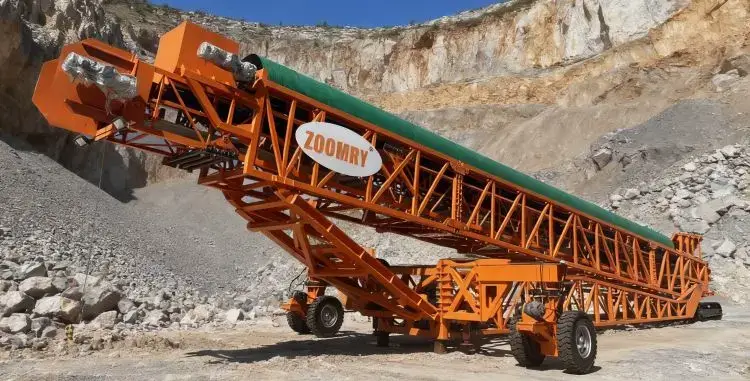
A stacker is a special complete set of equipment in the bulk material handling system, which efficiently, evenly and orderly stacks continuously conveyed bulk materials (including ore, coal, sand and gravel, grain, chemical raw materials, etc.) in the designated stockyard in accordance with process requirements. It is the core equipment connecting the whole process of bulk material transportation, storage, ship loading and truck loading.
Different from the extensive stacking mode relying on traditional fixed belts, forklifts and dump trucks for transportation, modern professional stackers have been upgraded from a single "material stacking" equipment to a comprehensive bulk material handling equipment integrating intelligent control, environmental protection, full-scene adaptation and system linkage. The mainstream models represented by the ZOOMRY ZR-SF Series Radial Telescopic Stacker are fully compliant with major international standards including CEMA, AS and GB, and have obtained global mainstream market certifications such as CE, EAC and KCS, which can meet the working conditions and compliance requirements of different regions around the world, including Europe, Russia, South Korea, Southeast Asia and Australia.
I. Core Functions of the Stacker
The core value of a stacker lies in solving the common problems existing in the traditional bulk material stacking mode, including low stockyard utilization rate, large material quality loss, high operation cost, difficulty in environmental compliance, and insufficient automation level.
1. Efficient Full-Scene Stockpiling
This is the most basic and core function of the stacker. Its essence is to break through the space limitations of traditional fixed equipment through the innovation of mechanical structure, so as to maximize the utilization of stockyard space and realize continuous stacking of materials.
- Space Utilization Optimization: The ZOOMRY Radial Telescopic Stacker realizes full-coverage and dead-angle-free operation of the stockyard through three core actions: radial slewing, boom telescoping, and luffing. With project-verified optimized design, it can increase the stockpiling capacity by up to 28% compared with the traditional fixed-length conveyor system, with a maximum stacking height of 20 meters, which can fully utilize the vertical and horizontal space of the stockyard. Taking the model with a 50-meter boom length as an example, for kaolin materials with an angle of repose of 45°, the maximum stockpiling capacity of a single area can reach more than 100,000 tons, far exceeding the traditional stacking methods.
- High-Capacity Continuous Operation: According to the capacity requirements of different industries, the stacker can be fully customized and adapted, with a belt width ranging from 800mm to 1600mm and a maximum conveying capacity of up to 3000m³/h. It can perfectly match the mass continuous operation needs of large mines, ports and aggregate plants, and completely solve the efficiency bottleneck of traditional intermittent transportation.
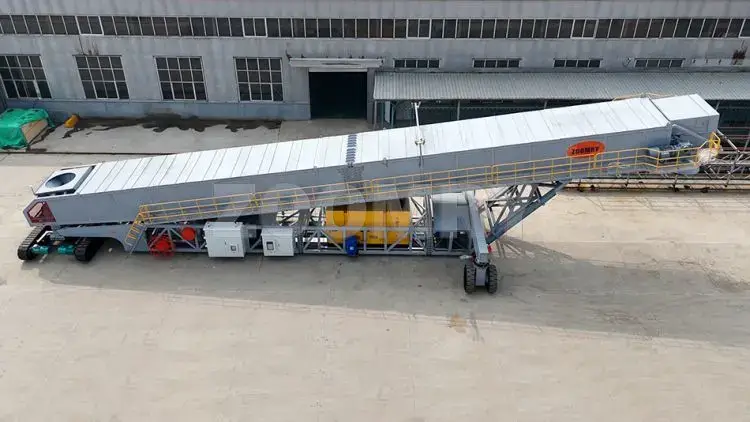
- Flexible All-Terrain Adaptation: Wheeled and crawler mobile stackers can realize free transfer in the site without large-scale civil engineering foundation, and can be put into use only with simple site leveling. It is perfectly suitable for scenarios where traditional fixed equipment cannot operate, such as complex terrain of mines, narrow wharves of ports, and temporary transfer stockyards, greatly reducing the preliminary infrastructure investment and approval costs.
2. Elimination of Loss and Pollution in the Stacking Process
For customers in mining, grain, building materials and other industries, the segregation, degradation, compaction and pollution of materials during stacking are the core causes of product quality degradation and economic losses. One of the core functions of the stacker is to solve this problem from the root of the process.
- Anti-Segregation Uniform Material Distribution: Through the PLC-controlled layered chevron stacking process, the stacker can realize continuous, uniform and thin-layer material distribution, completely avoiding the segregation problem of separation of bulk materials and fine materials in the traditional stacking method. It ensures the stable gradation of sand and gravel aggregates and the uniformity of ore grade, and avoids product downgrade losses caused by material segregation.
- Low-Loss Material Protection: The design of fully enclosed material guide chute, rubber skirt seal, and head polyurethane cleaning scraper can control the material transportation loss within 0.1%. At the same time, there is no need for forklifts and dump trucks to repeatedly roll the stacked materials, which fundamentally avoids the crushing, compaction and foreign impurity pollution of materials. It is especially suitable for materials with high added value and strict cleanliness requirements, such as gold ore, iron ore concentrate, and grain.
- Material Characteristic Adaptation: According to the angle of repose, abrasiveness and corrosivity of different materials, the stacker can customize and adjust the boom angle, belt material and idler type to adapt to the stacking needs of all types of bulk materials from coal, sand and gravel to chemical raw materials and grain.
3. Cost Reduction and Efficiency Increase in the Whole Link
For bulk material enterprises around the world, cost reduction and efficiency increase is the eternal core demand. By replacing the traditional construction machinery transportation mode, the stacker realizes a structural reduction in operating costs.
- Significant Reduction in Transportation Cost: Traditional bulk material stacking relies on repeated transportation by dump trucks and forklifts, and the cost of fuel consumption and equipment loss per ton of materials is generally 2-5 yuan. However, through continuous pipeline transportation, the operating cost per ton of materials of the stacker can be reduced to less than 0.5 yuan. For ports and mines with an annual throughput of 10 million tons, the annual savings can reach tens of millions of yuan only in terms of transportation cost.
- Optimization of Labor and Management Costs: Modern stackers can realize PLC-controlled fully automatic unmanned operation and full-function remote control within 300 meters. Only one operator is needed to complete the monitoring and management of multiple pieces of equipment. Compared with the traditional mode which requires multiple forklift drivers and on-site commanders, the labor cost can be reduced by more than 70%. At the same time, the standardized continuous operation mode greatly reduces the difficulty of on-site management and safety management costs.
- Controllable Full Life Cycle Cost: The core components (idlers, drums) of ZOOMRY stackers are all independently developed and produced. The service life of idlers can reach more than 50,000 hours, and the running resistance, sealing performance and noise indicators are all better than the national standards. At the same time, the equipment adopts a modular design, and the core components can be quickly disassembled and replaced, which greatly reduces the later operation and maintenance costs and downtime.
4. Multi-Mode Automated Safe Operation
Modern stackers have fully entered the intelligent era, and their core functions have been upgraded from "manually operated mechanical stacking" to "fully automatic, high-safety, self-adaptive intelligent operation", which can adapt to the operation needs of different regions and different working conditions around the world.
- Full Coverage of Three Operation Modes: ZOOMRY stackers are equipped with three standard operation modes: fully automatic PLC program control, HMI touch screen local control, and wireless remote control, which can be flexibly switched according to on-site working conditions. In the fully automatic mode, the stacking process can be preset to realize unattended operation of the whole process including layered stacking, automatic radial walking, and automatic boom telescoping and luffing. In the remote control mode, the operator can complete full-function operations such as emergency stop, boom telescoping, belt start and stop, radial movement, and inclination adjustment in a safe area, which is suitable for complex on-site environments such as mines and ports.
- Multiple Safety Protection Mechanisms: The equipment is equipped with standard belt deviation switch and emergency pull cord switch. The hydraulic winch system has a 0.01-second power-off self-locking function, and is equipped with double mechanical limits, which can lock the boom under the extreme condition of steel wire rope breakage to prevent safety accidents. The electrical system adopts IP65 protection rating, which can operate stably in the extreme climate environment of -30℃ ~ 60℃, and is suitable for harsh working conditions such as high cold, high temperature and high dust.
- Convenient Installation and Commissioning: Most of the structures of the equipment have been pre-assembled before leaving the factory. Each unit adopts a plug-and-play connector design, which can be integrally loaded into a 40-foot high cube container for global transportation. The on-site assembly and commissioning can be completed in only 10-20 days, which greatly shortens the project commissioning cycle of customers.
5. Seamless Linkage of the Whole System
The stacker is not an isolated equipment, but a core hub in the whole process of bulk material handling. Its core functions also include seamless linkage with upstream and downstream equipment to provide customers with one-stop bulk material handling solutions.
- Full Adaptation to Upstream and Downstream Equipment: It can be seamlessly connected with the full series of bulk material equipment, including pipe belt conveyors, long-distance land conveyors, heavy hopper feeders, truck unloaders, mobile ship loaders, and reclaimers, realizing the closed-loop operation of the whole process of "truck unloading - feeding - conveying - stacking - ship loading" without additional process transformation, which greatly improves the operation efficiency of the whole production line.
- Full-Process Service Capability Support: As a professional EPC general contractor for bulk material conveying, ZOOMRY can provide customers with full-process EPC+M+O services including design, manufacturing, installation, operation and maintenance, and upgrading based on the core functions of the stacker. It has provided thousands of technical consulting, equipment operation and maintenance, and production line upgrading services for nearly 200 customers around the world, which can ensure the stable operation of the equipment throughout its life cycle.
6. Global Environmental Compliance Adaptation
With the increasingly strict environmental regulations around the world, environmental compliance has become the core access threshold for bulk material enterprises, and the environmental protection function of the stacker has become an important part of its core competitiveness.
- Full-Dimensional Environmental Protection Design: The equipment adopts a fully enclosed material guide chute and dust-proof skirt design, which can greatly reduce dust emission during stacking. The low-noise idler design can control the operating noise within 45dB, which is far lower than the national standard requirement of 55dB, and can meet the strict noise control standards in Europe and the United States. At the same time, the continuous transportation mode replaces fuel-powered construction machinery, which can greatly reduce carbon emissions and exhaust pollution, and lower the carbon footprint of the project.
- Full Adaptation to Global Standards: ZOOMRY stackers can be adapted to major global design standards including CEMA (USA), AS (Australia) and GB (China) according to customer needs, and have obtained global mainstream market certifications such as CE (EU), EAC (Eurasian Economic Union) and KCS (Korea). It can perfectly meet the environmental and safety compliance requirements of different countries and regions around the world, and help customers successfully pass the local project approval.
II. Type Selection and Adaptation of Stackers
Stackers with different structural types have different focuses on core functions. Customers can carry out targeted selection according to their own material characteristics, site conditions, capacity requirements and process requirements:
- Radial Telescopic Stacker: Its core advantages are high stockyard utilization rate and large stockpiling capacity. It is suitable for long-term continuous stacking operations in large fixed stockyards, ports and wharves, and large aggregate plants. It is currently the most widely used mainstream model in the world.
- Wheeled Mobile Stacker: Its core advantages are flexible transfer and convenient installation. It is suitable for small and medium-sized aggregate plants, temporary transfer stockyards, and infrastructure construction sites with flat sites and frequent transfer.
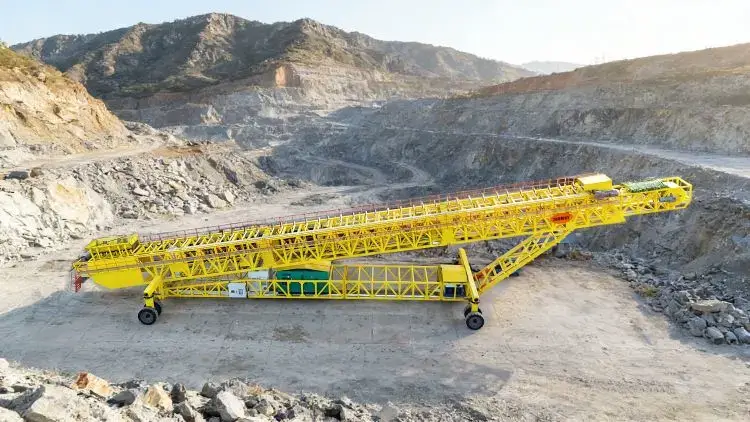
- Crawler Stacker: Its core advantage is strong terrain adaptability. It can operate stably in muddy, soft and rugged sites, and is suitable for operation scenarios such as open-pit mines, underground material transfer, and complex terrain.
- Stacking and Ship Loading Integrated Machine: Its core advantage is that it integrates the dual functions of stacking and ship loading, and can flexibly adapt to ships of different tonnages. It is suitable for integrated bulk material transfer and ship loading operations in ports and wharves, and can adapt to the full series of ship types including barges, handysize, Panamax and Capesize.
III. Global Typical Application Scenarios of Stackers
At present, stackers have been widely used in the whole industry of global bulk material handling, and their core functions have realized targeted value implementation in different scenarios:
- Port and Wharf Industry: It meets the needs of rapid bulk material transfer and ship loading linkage in the narrow space of ports, greatly improves port handling efficiency, reduces ship detention time, and is the core equipment of the global port bulk material transfer system.
- Mining Industry: It meets the needs of long-distance material transportation and low-cost stacking in open-pit/underground mines, replaces the high-cost truck transportation mode, greatly reduces the operating cost of mines, and adapts to the complex mine terrain.
- Sand, Gravel Aggregate and Building Materials Industry: It solves the segregation problem of aggregate stacking, ensures the stable gradation of concrete aggregate, and meets the strict environmental protection requirements of the industry. It is the core supporting equipment of the green building material production line.
- Thermal Power and Coal Chemical Industry: It realizes continuous and stable stacking of coal, ensures the stable supply of power plant fuel, and meets the safety specification requirements of the industry through dust-proof and explosion-proof design, which is suitable for 24-hour continuous operation requirements.
- Grain and Agriculture Industry: It realizes low-loss and pollution-free stacking of grain, avoids breakage, mildew and pollution of grain during transportation, ensures grain quality, and is suitable for the operation requirements of granaries and port grain transfer.
With the intelligent and green transformation of the global bulk material industry, the functions of stackers are also continuously upgraded. In the future, there will be three core development trends: First, intelligent and unmanned upgrading. Through AI visual recognition, digital twin and Internet of Things technology, it will realize the whole process of unmanned and self-adaptive operation of the stacking process, as well as remote predictive operation and maintenance. Second, green and low-carbon upgrading. New energy power such as lithium battery and hydrogen energy will gradually replace the traditional diesel power to achieve zero-emission operation. At the same time, the dust-proof and noise reduction design will be further optimized to meet the stricter global environmental protection requirements. Third, modular and lightweight upgrading. Through structural optimization, it will further improve the convenience of equipment transportation and installation, and shorten the commissioning cycle and preliminary investment of customers.