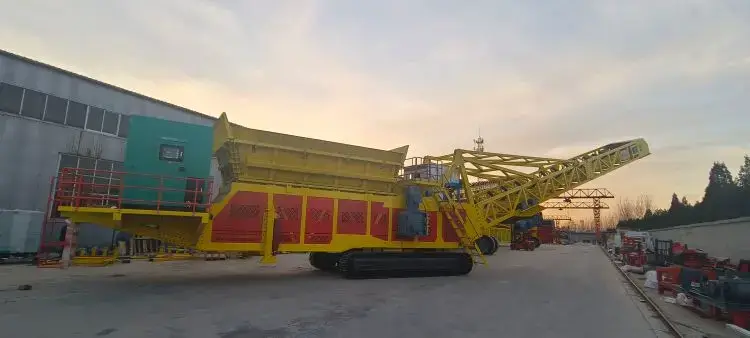
The Port-Specific Hopper Feeder is tailored to meet the operational requirements of ports featuring high throughput, diverse material types and complex site conditions. In comparison with general-purpose stackers, the Hopper Feeder has undergone targeted structural optimizations: its wide-caliber hopper with 60-70° inclined side walls prevents material blockage, making it suitable for the large-volume unloading capacity of grab cranes; a heavy-duty body and reinforced chassis cope with hardened dock pavements and frequent site relocation; an electrical system with IP65 protection class resists salt spray corrosion and high-dust environments; compliance with EU Stage V/Tier 4 Final emission standards meets the environmental requirements of ports worldwide; with a maximum handling capacity of 3500 Tons Per Hour (TPH), it perfectly matches the high-intensity demands of 24/7 continuous operation at ports.
The basic working process of the Hopper Feeder at ports is as follows: front-end feeding equipment (grab cranes, truck unloaders, etc.) unloads bulk materials into the hopper → a 6mm thick hardened steel liner inside the hopper protects the body from the impact of large materials, and an optional agitator solves the problem of material bridging and blockage for biomass, wet coal and other materials → the PLC control system adjusts the conveying speed via frequency conversion and speed regulation according to the capacity of downstream equipment → the belt (EP multi-layer wear-resistant type) or chain plate (heavy-duty type) conveying structure uniformly transfers bulk materials to target equipment (mobile shiploaders, belt conveyors, etc.) → real-time synchronous monitoring of abnormal conditions such as material blockage, overload and belt deviation triggers an alarm or emergency stop protection to ensure operational safety.
Operating Modes of the Port-Specific Hopper Feeder
In port operations, the standalone use of the Hopper Feeder is mainly applicable to scenarios such as temporary transshipment, small-batch bulk material handling and emergency material replenishment, for example, the unloading of small bulk carriers arriving at the port temporarily, local material replenishment in the yard, and emergency transshipment during equipment maintenance. The standalone Hopper Feeder requires no complex equipment connection and can quickly respond to the sudden operational demands of ports with its independence and flexibility.
The specific working process is as follows: First, operators move the crawler-type (suitable for uneven dock ground) or wheel-type (fast site relocation) Hopper Feeder to the operation position through remote control or on-site operation, and the hydraulic leveling system quickly calibrates the body to ensure the hopper receives materials horizontally; Then, the grab crane unloads bulk materials (such as iron ore, coal) into the hopper in batches according to the hopper capacity, the inclined side walls and anti-blockage design prevent material accumulation, and the hardened steel liner resists the impact and wear of large materials with a maximum particle size of 250mm; Next, the PLC control system starts the conveying system – heavy-duty models adopt chain plate conveying (tear-proof and heavy-load resistant), while light-duty models use EP500 wear-resistant belts (suitable for fine materials such as grain) – the conveying speed is adjusted according to the unloading demand, and bulk materials are directly transferred to temporary stockpiles, small transport vehicles or designated storage areas at the dock via the conveying structure; During operation, the dust cover and pulse dust removal system integrated into the equipment reduce bulk material dust emissions in line with port environmental protection requirements, and the salt spray anti-corrosion coating effectively resists the humid and corrosive environment of coastal ports.
The core advantage of the standalone operating mode is flexibility, high efficiency and quick response. It can complete the entire process of material receiving, conveying and unloading with a single unit without the need to build an equipment connection system in advance. It is especially suitable for scenarios such as sudden material replenishment and small-batch bulk material transshipment at ports, which can effectively shorten the operation preparation time and improve the emergency handling capacity of port logistics. The stability of ZOOMRY's Port-Specific Hopper Feeder in standalone operation has been verified at numerous ports around the world. For instance, a bulk terminal in Southeast Asia achieved 72 hours of trouble-free continuous operation with a single unit during emergency unloading operations in the typhoon season, handling 50,000 tons of materials and ensuring the smooth departure of the ship.
Cooperative Operating Mode with Truck Unloaders
The connection between the Truck Unloader and the Hopper Feeder is a general process for the "land-based bulk material inbound and transshipment" at ports, applicable to the centralized transshipment scenario where incoming bulk materials (such as ore transported from mines and coal transported from power plants) are delivered to the port by trucks. The seamless cooperation of unloading and feeding solves the pain points of low truck unloading efficiency, bulk material spillage and mismatched capacity, realizing the rapid inbound and efficient transshipment of land-based bulk materials, and it has become the mainstream configuration for land-based bulk material handling at ports.
The core logic of the cooperative operation is capacity matching, precise linkage and safety & environmental protection. The specific working process is as follows:
Pre-connection Preparation: The Truck Unloader and the Hopper Feeder complete network linkage in advance through the PLC system, and parameters are preset according to truck transport capacity and bulk material types (such as large ore, viscous coal, grain) before operation. Meanwhile, the Truck Unloader can flexibly adopt a wheel-type or crawler-type chassis according to port site conditions – the wheel-type is suitable for hardened dock pavements, while the crawler-type features a low ground pressure of 80kPa for soft transshipment areas. After the Hopper Feeder moves to the designated working position under the Truck Unloader, it locks the position through hydraulic leveling, and the hopper opens anti-spill enclosures to form a closed connection space, avoiding bulk material spillage from the source.
Truck Unloading Link: Trucks transporting bulk materials drive into the positioning area of ZOOMRY's Truck Unloader and complete automatic body fixation without manual auxiliary calibration. Then, the hydraulic system controlled by a closed-loop proportional valve (response time < 8ms) drives the turning plate to tilt the truck carriage smoothly, and bulk materials fall into the built-in conveyor belt of the Truck Unloader by gravity. The belt is designed with precise speed regulation to keep in sync with the feeding rhythm of the Hopper Feeder, conveying bulk materials stably and uniformly to the feed inlet of the Hopper Feeder below, avoiding material splashing or hopper impact caused by direct falling. At the same time, the belt conveying section of the Truck Unloader is equipped with a sealed cover and guide plate to further guide materials into the hopper accurately, and together with the rubber gaskets on the edge of the hopper, it forms a fully enclosed conveying channel, eliminating bulk material spillage throughout the process from unloading to feeding. Notably, ZOOMRY's Truck Unloader supports 2-4 lane design, enabling parallel unloading of multiple trucks and greatly improving the centralized handling efficiency of inbound bulk materials at the port.
Hopper Buffering and Conveying Link: The large-capacity design (12-24 cubic meters) of the Hopper Feeder provides sufficient buffering space for the unloading process, perfectly matching the high-efficiency performance of the Truck Unloader that can unload 30 tons of bulk materials in 3-10 minutes, and avoiding material blockage caused by fluctuations in unloading speed. Aimed at the characteristics of different bulk materials, the agitator inside the hopper (for preventing bridging of wet and sticky materials) and the 6mm hardened steel liner (for resisting wear of large ore) work together to ensure the smooth sliding of materials; the PLC control system automatically adjusts the conveying speed according to real-time material level data, and uniformly transfers bulk materials to downstream equipment such as belt conveyors and telescopic stackers at the dock, realizing the centralized stockpiling or further transshipment of bulk materials. In this process, the EP-grade wear-resistant belt of the Truck Unloader and the conveying system of the Hopper Feeder form a wear-resistant synergy, extending the service life of the entire set of connected equipment.
Linkage Protection and Environmental Treatment: During the connection process, the safety systems of the two sets of equipment are deeply linked – if abnormal conditions such as material blockage and overload occur in the hopper, a signal will be sent to the Truck Unloader immediately to trigger the equipment to stop unloading operations, which will resume automatically after the fault is eliminated; at the same time, the driving parts of the Truck Unloader are equipped with full protective covers, and the edge of the Hopper Feeder's hopper is fitted with rubber gaskets, forming a dual safety protection that not only prevents accidental injury to operators but also avoids equipment damage caused by environmental factors. In terms of environmental protection, the sealed cover of the Truck Unloader and the dust cover of the Hopper Feeder form a closed protection, and together with the pulse dust removal system, the dust emission concentration is controlled within the scope of international environmental protection standards; for the salt spray environment of coastal ports, metal components at the connection parts are all treated with anti-corrosion coatings complying with ISO 12944-5 standards to extend the service life of the equipment. In addition, ZOOMRY's Truck Unloader reduces the number of truck trips to and from the yard by optimizing the logistics process, lowering fuel consumption and carbon emissions, and forms an environmental synergy with the hybrid/pure electric power options of the Hopper Feeder, complying with international environmental protection standards such as EU Stage V and US EPA Tier 4 Final.
The linked operation of the Truck Unloader and the Hopper Feeder shortens the unloading time of a single truck from 30 minutes of traditional manual unloading to less than 10 minutes, with an hourly handling capacity of up to 3500 TPH, meeting the demand for large-scale land-based bulk material inbound at ports; the seamless connection reduces bulk material spillage and loss (the loss rate is reduced from 5% to below 0.5%), and automatic control cuts down labor input.
Cooperative Operating Mode with Mobile Shiploaders
The connection with Mobile Shiploaders is applicable to the rapid loading of bulk materials stockpiled at ports (such as ore, grain) into ocean-going cargo ships, or the direct receiving of bulk materials from ship unloaders for transshipment and loading. The core demands of this connection mode are high-precision material distribution, high throughput and adaptability to different ship types. Through structural optimization and intelligent linkage of equipment, ZOOMRY has realized the seamless cooperation between the Hopper Feeder and the Mobile Shiploader, making it the core power for port loading operations.
The specific cooperative working process is as follows:
Operation Planning and Equipment Positioning: According to the hold size and load requirements of the to-be-loaded cargo ship, the loading path and material distribution density are preset through the central control system; the Hopper Feeder moves to the position below the feed inlet of the Mobile Shiploader via a wheel-type chassis (fast site relocation), and the boom angle (up to 24m in length) is adjusted to achieve precise docking between the conveying end and the feed inlet of the shiploader with an error controlled within ±5cm; the Mobile Shiploader adjusts its body position and material distribution height in advance according to the hold position.
Bulk Material Receiving and Preprocessing: For the yard-to-ship process, the Hopper Feeder receives bulk materials from the telescopic stacker or reclaimer; for the ship-unloading-to-transshipment process, it directly receives bulk materials from the grab ship unloader; the anti-stick belt (for grain, wet coal) and agitator (for biomass) inside the hopper ensure no material blockage or residue, and the hardened steel liner resists the impact of large ore to guarantee continuous operation.
Linked Conveying and Precise Material Distribution: The PLC control system realizes speed linkage between the Hopper Feeder and the Mobile Shiploader, and the feeding speed is adjusted in real time according to the moving speed of the shiploader and the material distribution demand of the hold to avoid insufficient feeding or material overload; the conveying structure of the Hopper Feeder adopts a long boom belt with a certain tilt angle adjustment capability, which can adapt to the feeding heights of different ship types; the Mobile Shiploader moves according to the preset path and uniformly distributes the bulk materials conveyed by the hopper to each hold to ensure the balanced stress of the ship body.
Safety and Compliance Assurance: Anti-spill baffles and sealed covers are set at the connection parts to reduce dust emissions during loading; the overload alarm and deviation detection system of the Hopper Feeder are linked with the emergency braking system of the shiploader, which will stop the machine immediately in case of an abnormality to avoid equipment damage or material spillage; for perishable materials such as grain, the aeration device inside the hopper reduces material mildew and ensures cargo quality; the entire equipment complies with the safety standards of international shipping and is suitable for loading operation specifications at different ports around the world.
The connection with the Mobile Shiploader meets the rapid loading demand of large cargo ships, shortening the ship's port detention time by more than 30%; on the other hand, the precise material distribution enabled by intelligent linkage avoids problems such as hold unbalance and material accumulation, reducing shipping safety risks.
Multi-Equipment Cascade Operating Mode
In the large-scale bulk material handling scenarios of large ports, the connection of a single piece of equipment can no longer meet the efficiency requirements of the entire process of unloading, transshipment, stockpiling and loading. At this time, the port-specific Hopper Feeder will serve as the core hub and be integrated into the multi-equipment cascade system of "grab ship unloader → Hopper Feeder → belt conveyor → telescopic stacker → mobile shiploader", realizing the fully automated handling of bulk materials from ship unloading to ship loading, which is also the mainstream operation mode of large ports worldwide at present.
The working logic of multi-equipment cascade is full-process linkage, capacity balance and intelligent regulation. The specific working process is as follows:
Front-End Ship Unloading and Initial Transshipment: The grab ship unloader unloads bulk materials (such as iron ore, coal) from ocean-going cargo ships and accurately unloads them into the hopper of the port-specific Hopper Feeder; as a buffering hub, the Hopper Feeder receives the large-volume unloading capacity of the ship unloader to avoid the shutdown of downstream equipment due to excessive instantaneous load; bulk materials are uniformly transferred to the belt conveyor (the supporting idlers, rollers and other parts of ZOOMRY ensure conveying stability) through the frequency conversion and speed regulation system.
Intermediate Stockpiling Link: The belt conveyor transfers bulk materials to the Telescopic Stacker for centralized stockpiling; in this process, the PLC system of the Hopper Feeder is linked with the belt conveyor and the telescopic stacker, adjusting the feeding volume according to the stockpiling speed of the stacker to ensure capacity balance throughout the process without material blockage or interruption; for bulk materials requiring preprocessing (such as crushing and screening), the Hopper Feeder can directly transfer the materials to the crushing station, and then to the stacker via the belt conveyor.
Back-End Ship Loading and Flexible Allocation: When the stockpiled bulk materials need to be loaded and shipped out, the reclaimer takes materials from the stockpile and conveys them to the Hopper Feeder again; the Hopper Feeder adjusts the feeding speed and conveying direction according to the loading demand of the Mobile Shiploader to transfer bulk materials to the shiploader; if the port has multiple loading tasks at the same time, the coordinated allocation of multiple Hopper Feeders can realize simultaneous loading operations for different stockpiles and different ship types, improving the overall operational efficiency of the port.
Full-Process Intelligent Control: The cascade system realizes centralized monitoring through the central control platform, displaying real-time information such as the operating status, material level data and fault early warning of each piece of equipment; operators can remotely adjust the parameters of each piece of equipment without on-site operation, realizing unmanned operation; the system supports data traceability and analysis, providing data support for ports to optimize operation processes and reduce energy consumption; all equipment complies with international environmental protection and safety standards to ensure the compliance of the entire process of operation.
The advantages of the multi-equipment cascade mode are large-scale operation, automation and high efficiency. It can meet the bulk material handling demand of more than 100,000 tons per day at large ports, while greatly reducing labor input and lowering operational costs and safety risks.
Choose ZOOMRY's Port-Specific Hopper Feeder
The complex operating environment of ports (salt spray, high dust, high intensity, continuous operation) puts extremely high demands on the reliability of equipment. Through a series of targeted designs, ZOOMRY provides all-round protection for the stable operation of the Hopper Feeder:
Power Assurance: Three power modes are available – diesel-hydraulic (for non-power supply scenarios), hybrid (energy-saving type) and pure electric (environmental protection scenarios), adapting to different power supply conditions at ports; the hybrid/pure electric modes achieve 20%-25% lower energy consumption than traditional diesel models, in line with the global port environmental protection trend.
Protection Assurance: The body is coated with salt spray anti-corrosion paint, the electrical system reaches IP65 protection class to resist humidity, corrosion and dust; the hopper is built-in with a hardened steel liner and anti-spill enclosures, and the conveying structure adopts wear-resistant belts/chain plates, extending the service life of wear parts by more than 30%.
Maintenance Assurance: A centralized lubrication system and large-size access door design reduce maintenance time; wear parts (belts, liners, idlers, etc.) feature high universality and can be replaced quickly; the equipment supports disassembly and transportation (suitable for 40ft HC containers), facilitating cross-port site relocation and maintenance.
Compliance Assurance: Compliance with EU Stage V/Tier 4 Final emission standards, IP65 protection standards, international shipping safety standards, etc., enabling adaptation to the port operation requirements of different regions around the world without additional modification.